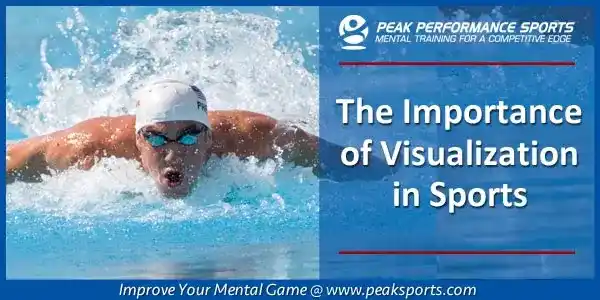
The Importance Of Visualization In Sports
Sports visualization is an experience… a training experience, a preparation experience and a warm-up experience. Visualization for athletes is a skill that you can improve and benefit from.
Whether you realize it or not, you visualize during sports or mentally rehearse naturally. Everyone thinks in pictures. Some athletes unintentionally have recurring images of missed opportunities, injuries, mistakes and losses.
There is one thing that separates elite athletes from average athletes… Elite athletes utilize the power of guided imagery or visualization. Imagery has long been a part of elite sports and many Olympic athletes have mastered the skill with the help of Sport Psychologists and Mental Game Coaches.
Guided visualization or imagery for athletes is consciously controlling the images or directing an athletic script in your head. One example of guided imagery that you having unknowingly used is when your coach was teaching you a new skill. You created an image in your mind of how the skill should look or the successful execution of the skill.
Guided visualization or imagery is purposely rehearsing a skill, routine or performance in your mind’s eye to program your body for success. However, sports visualization or mental imagery is more than just a visual experience. Many athletes prefer to feel movements and engage in the kinesthetic past of imagery.
Olympians and Visualization in Sports
As Olympic athletes gear up for 2016 Rio Olympic Games, many athletes are following the successful blueprints laid out by their 2014 winter Olympic counterparts who competed successfully in Sochi.
Canadian bobsledder Lyndon Rush credited imagery with helping him keep his head in the game throughout the long, arduous four years of training between the 2010 and 2014 Olympic Games.
RUSH: “I’ve tried to keep the track in my mind throughout the year. I’ll be in the shower or brushing my teeth. It just takes a minute, so I do the whole thing or sometimes just the corners that are more technical. You try to keep it fresh in your head, so when you do get there, you are not just starting at square one. It’s amazing how much you can do in your mind.”
Emily Cook, veteran American freestyle skier and three-time Olympian, described how her specific imagery scripts and mental rehearsal involving all the senses have helped her maintain longevity in her sport.
COOK: “Visualization, for me, doesn’t take in all the senses. You have to smell it. You have to hear it. You have to feel it, everything.”
COOK: “I would say into a [tape] recorder: ‘I’m standing on the top of the hill. I can feel the wind on the back of my neck. I can hear the crowd,’ kind of going through all those different senses and then actually going through what I wanted to do for the perfect jump. I turn down the in-run. I stand up. I engage my core. I look at the top of the jump. I was going through every little step of how I wanted that jump to turn out.”
Nicole Detling, a sports psychologist with the United States Olympic team explains the importance of having a multi-sensory approach when visualizing.
DETLING: “The more an athlete can image the entire package, the better it’s going to be.”
Michael Phelps and the 2016 Olympics
Michael Phelps is already the most decorated Olympian of all time with 22 medals to his name including 18 gold medals. The 2016 Rio Olympics will be Phelps’ fifth Olympic Games and, once again, he is using the power of guided imagery to prepare for success.
Bob Bowman has been Phelps’ coach since he was a teenager and has included mental imagery or visualization as a part of Phelps’ mental training.
Bowman instructed Phelps to watch a “mental videotape” of his races every day before he went to sleep and when he woke up in the morning. Phelps would visualize every aspect of swimming a successful race starting from the blocks and culminating in a celebration after the race was won.
Bowman would instruct Phelps to “Put in the videotape” during training sessions to help motivate Phelps to push harder.
Bowman believes that mental imagery helped Phelps develop the habit of success.
BOWMAN: “We figured it [imagery] was best to concentrate on these tiny moments of success and build them into mental triggers… It’s more like his habits had taken over. The actual race was just another step in a pattern that started earlier that day and was nothing but victories. Winning became a natural extension.”
Why is visualization or mental imagery such a powerful tool for success?
When athletes visualize or imagine a successful competition, they actually stimulate the same brain regions as you do when you physically perform that same action.
Visualization in sports or mental imagery is a way of conditioning for your brain for successful outcomes. The more you mentally rehearse your performance, the more it becomes habituated in your mind.
Think of visualization in sports as a pregame walk-through. Many basketball teams and football teams conduct rehearsals or walk-throughs the day before a big game to fortify their game strategy and become familiar with what to expect during game situations.
Athletes who use visualization can eliminate some of the unknowns that create competitive anxiety. When athletes use visualization, they not only see the action unfold but truly feel the event take place in their mind’s eye.
Visualization for athletes is the tool great performers use to help them succeed and stay on top of their game mentally.
How to Use Sports Visualization For successful Performance:
- Visualize the outcome you want – When you mentally rehearse your performance in your head, make sure you see the event as how you want it to unfold. If your mental images turn negative, stop the mental tape, rewind and restart then visualize again see the performance you want to see.
- Use all your senses from a first-person perspective – Visualize your sports performance in detail. What would you see, hear, feel, smell and taste. Feel how your body would feel as you go through the motions of your performance. Try adding in some physical movements that coincide with the visualized images. Feel the excitement of successfully fulfilling your performance goal.
- Practice frequently – Mental rehearsal for athletes is a skill that becomes better with repetition. Practice your visualization or imagery daily.
- If you want to take advantage of the power of visualization, consult with a Mental Game Coach about incorporating this essential skill into your training.
Sports Psychology Podcasts
*Subscribe to The Sports Psychology Podcast on iTunes
*Subscribe to The Sports Psychology Podcast on Spotify
Download a free sports psychology report to improve your mental game!
Learn more about our one-on-one mental game coaching.
The Confident Athlete

“The Confident Athlete” consists of 2 audio programs that include 14 days of confidence fueling exercises and a simple to follow workbook that guides you through the 14 days, helps you apply the strategies, and customizes the exercises to your personal needs.
Let me help you put a stop to the confidence leak. You can learn to have greater levels of confidence in competition than you do in practice by identifying the specific ways you undermine your own confidence and how to convert your practice confidence into COMPETITIVE CONFIDENCE.
“The Confident Athlete” is a ground-breaking system to teach you how to think like a champion and have ultimate self-confidence every time you step on the playing field, court, track, or course. The confident athletes was developed for any athlete – junior to professional –that wants to gain confidence. However, coaches and sports parents can learn how to teach others to perform with ultimate confidence. Use my program if you want to bust a slump or just wanting higher or more consistent levels of self-confidence.